 |
LANLINGTECH CO., LIMITEDThe Pro manufactuer of stage laser lights and LED lights in China |
|
||||||





Contact Us


Products >
Indoor Animation lasers >
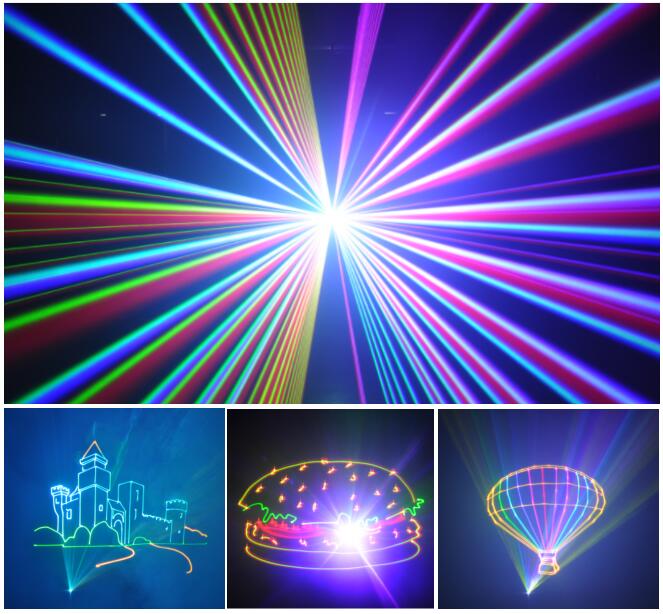
Transformer 10W RGB 30K ILDA Animation Laser Light

Product Description:
Transformer 10W RGB 30K ILDA Animation Laser Light
Laser power: 10W RGB (Red: 3W, Green: 3W, Blue: 4W, blended white: 10W).
Laser power: 10W RGB (Red: 3W, Green: 3W, Blue: 4W, blended white: 10W).
Laser color: RGB
Modulation signal: TTL/Analogue modulation, switching via LCD display
Scanning system: 30kpps scanning galvo systems, upgrading speed at request
Scanning angle: ± 20 º
Channel mode: 12CH DMX channels
Display: LCD display operation
Control mode: auto running, Sound-activated, DMX512, master-slave, ILDA/PC, APP Bluetooth by mobile phone
ILDA Interface: DB25/RJ45
Interface: 3 pins XLR jack for DMX or Maser-Slave linking
Cooling system: fan cooling
Working voltage: AC90-240V, 50~60Hz
Rated power: 200W
Working environment: indoor (10-35°)
Product size: 30.6*27.6*20.3cm (LxWxH)
Net Weight: 8.5kg
Package Content: 1x Laser Projector, 1x Power cable, 1x English user manual
Laser lights are generally divided int 2 modulations:
(1) TTL digital modulation
(2) Analogue modulation
Analog modulation
An analog signal is used to control the intensity of the output beam. This signal is usually a voltage in the range of 0 V to 5 V. With an RGB laser and analog modulation you have, with an 8 bit system, 16.7 million colours at your disposal.
However, since most laser show softwares uses a 0-100% control for laser brightness modulation (so 100 steps instead of 255), the total of available colours at disposal is 1'000'000. Furthermore, usual laser sources start lasing at a voltage between 1-2 volts and reach their full brightness at voltages between 3.5-4V, and the power/voltage curve between these points are usually not perfectly linear. Consequently the dynamics of the color palette in a real lasershow use is decreased to only a few thousands of different colors.
TTL Modulation
TTL modulation indicates that the laser does not support analog modulation of the output but only ON / OFF control. See blanking. With an RGB laser and TTL blanking you have seven colours at your disposal. Red, Green, Blue, Cyan, Magenta, Yellow, White.
Laser lights are generally divided int 2 modulations:
(1) TTL digital modulation
(2) Analogue modulation
Analog modulation
An analog signal is used to control the intensity of the output beam. This signal is usually a voltage in the range of 0 V to 5 V. With an RGB laser and analog modulation you have, with an 8 bit system, 16.7 million colours at your disposal.
However, since most laser show softwares uses a 0-100% control for laser brightness modulation (so 100 steps instead of 255), the total of available colours at disposal is 1'000'000. Furthermore, usual laser sources start lasing at a voltage between 1-2 volts and reach their full brightness at voltages between 3.5-4V, and the power/voltage curve between these points are usually not perfectly linear. Consequently the dynamics of the color palette in a real lasershow use is decreased to only a few thousands of different colors.
TTL Modulation
TTL modulation indicates that the laser does not support analog modulation of the output but only ON / OFF control. See blanking. With an RGB laser and TTL blanking you have seven colours at your disposal. Red, Green, Blue, Cyan, Magenta, Yellow, White.